
 Deutsch
 English

Nanobubble-induced centrifugal field flotation of nanoparticles
Author: Juliana Rivas-Botero
Flotation is a well-established technology that has played an important role in mineral processing, paper recycling, and water treatment for decades. However, there are certain limitations regarding the size of the particles that can be separated, with a minimum size of approximately 40 µm. These small particles approach the gas bubbles with kinetic energy that is too low to overcome the surrounding film (energy barrier). As a result, entrapment is highly unlikely, leading to low process efficiency.
The goal of this project is the selective separation of nanoparticles (NP) smaller than 10 µm from a liquid using a centrifugal field induced by nanobubbles (NB). To achieve this, nanoparticle suspensions are gas-flushed with filtered air at various pressures. During this process, nanobubbles (NB) form on the cracks or irregularities of the surface of the gas-flushed nanoparticles (NP), as these serve as nucleation sites for NB formation. The formation of NB depends on the particle morphology and the properties of the particle surface (e.g., structure, chemistry, and substance-specific hydrophobicity of the surface). Depending on the surface properties of the nanoparticles, the NB either become free NB or remain bound to the surface of the NP. The free NB, the NP, and the nanobubble clusters are investigated.
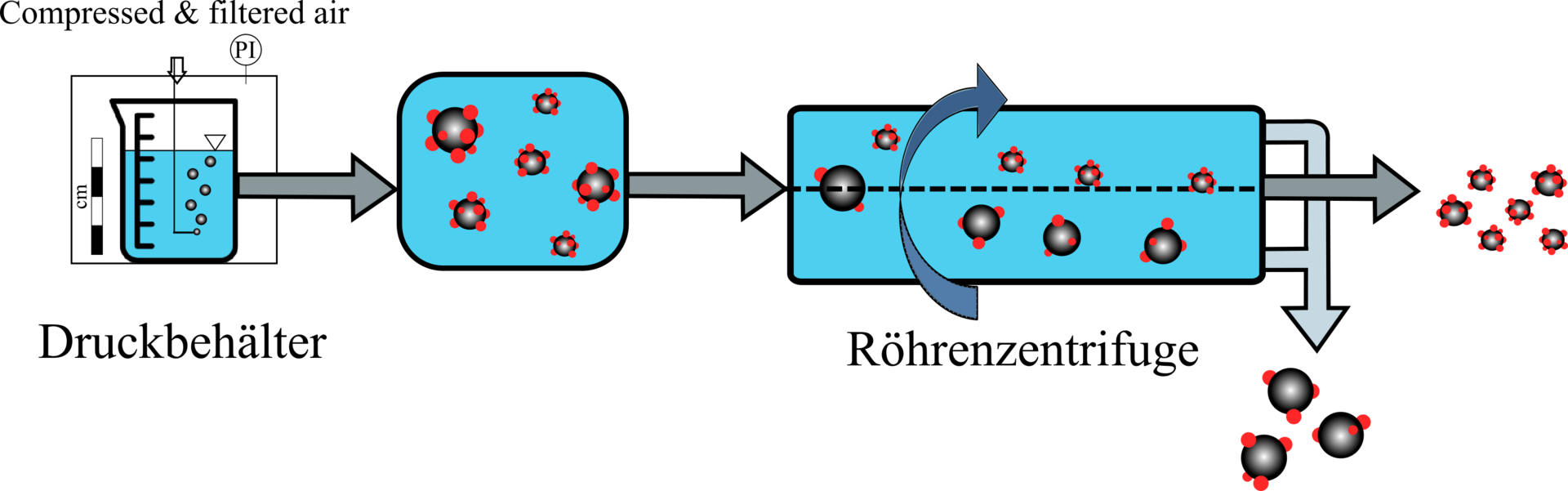
A key step in the process is the nucleation of NB on the surface of the particles during pressure relief. A special air injection system is used here to adjust the saturation of the suspensions with purified, particle-free air. Decompression problems, such as cavitation effects and shear stresses on the NP-NB aggregates in the suspension, are avoided by moderate pressure relief through the gas phase.