
 Deutsch
 English

High-resolution deflector wheel sifter for the dry fractionation of submicron particles at high feed rates with integrated material sorting
Author: Leonard Hansen
In the field of ultrafine particles, dry classification of industrially relevant quantities is dominated by the deflector wheel classifier, which exhibits separation limits in the range of a few micrometers at high feed rates. In this project, the goal was, on the one hand, to lower the separation limit and, on the other hand, to combine aerodynamic classification in the ultrafine particle range with material-specific sorting based on triboelectric charging. During the first funding period, a new classifier and a new vortex separator were designed. In addition to building the apparatus, the goal of the first phase was to gain a deeper understanding of particle motion within the classifier and of triboelectric charging (Figure 1).
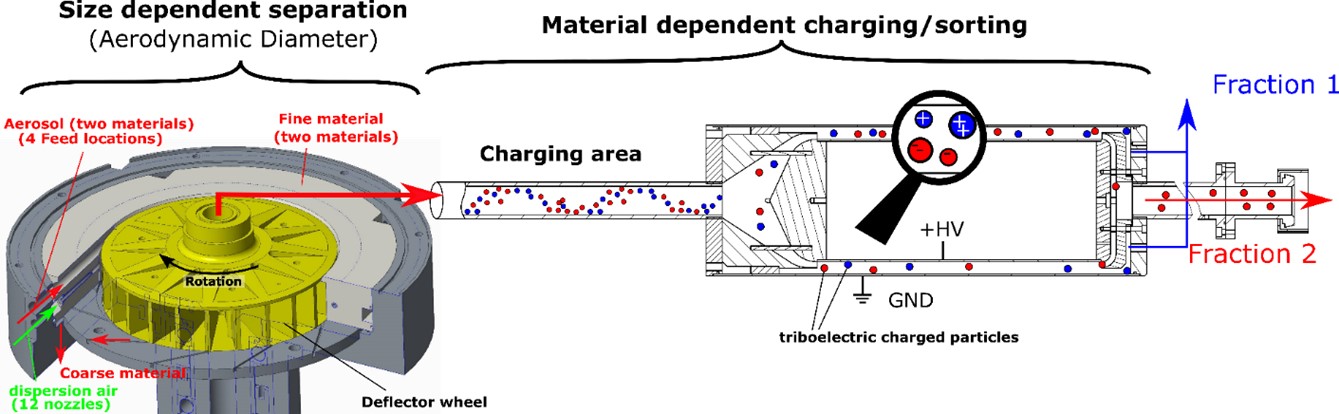
Separation in the deflector wheel separator is achieved through the balance of forces between the drag force (acting inward) and the centrifugal force (acting outward). The centrifugal field is generated by a rotating rotor in the center. A blower at the end of the system creates an air draft, which in turn generates the drag force on the particles. This results in a balance of forces at a specific particle size—the cut size.
During the separation process, the particles collide with various components of the separator. These impacts and friction during the screening process cause the particles to become electrically charged (triboelectric charging). This effect is intended to facilitate material-specific sorting through the clever utilization of airflows and an electric field in an integrated electrostatic separator.