
 Deutsch
 English

Production of piezoelectric PVDF by spray drying
Author: M.Sc. Jens Wiegmann
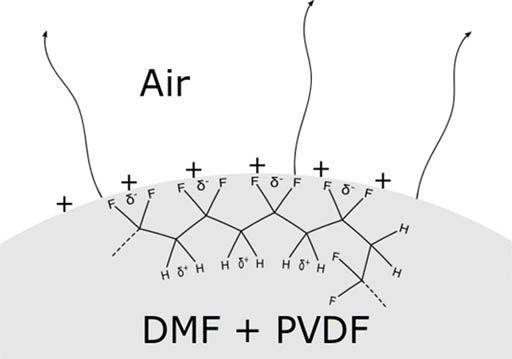
In addition to conventional piezoelectric materials, polymers can also exhibit piezoelectric properties. Polyvinylidene fluoride (PVDF) is one such polymer and is used in sensor and/or actuator applications. PVDF occurs in five known conformations, one of which—the beta phase—exhibits the strongest piezoelectric properties. The nonpolar alpha phase is the most common conformation and is predominantly formed through conventional manufacturing processes. The transition from the alpha phase to the beta phase can occur through various means, such as mechanical stress or the application of an electric field, but also through crystallization at low temperatures and thus with slow crystallization kinetics. When forming the beta phase from dissolved PVDF, the evaporation rate is therefore a critical parameter. Consequently, work is underway to develop a continuous, single-step spray-drying process for PVDF, thereby avoiding the conventional and labor-intensive batch processes used to treat PVDF. The study investigates under which process conditions the piezoelectrically active beta phase is preferentially formed. To this end, various spray-drying process parameters are varied. To influence the evaporation rate, drying parameters such as relative humidity and drying temperature are adjusted. Furthermore, in addition to pneumatic atomization, atomization via electrospray is also being investigated. In this process, the liquid is atomized into fine, uniform droplets by applying an electric field; additionally, an electric charge is transferred to the droplets. In the experiments with electrospray, an increase in the beta-phase fraction of PVDF was observed. This increase can be explained by the application of the charge. The applied charge interacts with the partial charges in the polymer and thus promotes alignment toward the beta phase. The electrospray process is therefore very well suited for depositing very thin piezoelectric layers onto surfaces.