
 Deutsch
 English

Nanoparticle synthesis in spray flames (SpraySyn): measurement, simulation, processes
Author: Jalal Poostforooshan
One obstacle to the large-scale commercial use of flame spray pyrolysis (FSP) is the need to use solvents or precursors, which are often expensive. Therefore, expanding the range of liquid starting solutions to include aqueous and organic salt solutions would significantly broaden the spectrum of potential cost-effective FSP applications. A prerequisite for the use of aqueous solutions appears to be a sufficiently fine droplet size. While pneumatic atomization can also finely disperse aqueous solutions, this process requires large amounts of atomizing gas. Therefore, in this project, electrohydrodynamic atomization (EHDA, electrospray) of aqueous and organic solutions was coupled with FSP (see Fig. 1).
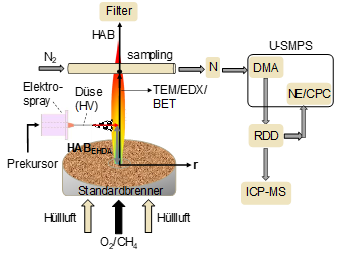
EHDA enables the virtually pressureless atomization of solutions into nearly monodisperse droplets with an adjustable diameter ranging from a few micrometers to several hundred micrometers. The electrically charged precursor droplets are transported from the electrospray nozzle into the ground-side flame by electrostatic forces, thereby completely eliminating the need for a dispersion gas. Because the flame and spray processes are decoupled, there is great flexibility regarding the arrangement and number of electrospray nozzles, which greatly simplifies scale-up and the production of multicomponent materials.